The noise drew me away from the dinner table. (Good thing I’m an adult and this kind of thing is allowed.) At first I thought it was my drummer neighbour experimenting. But the sound was coming from the wrong direction, and really, it wasn’t very musical. I went outside and looked up. Way up. There it was! No, there they were! A pair of pileated woodpeckers (dryocopus pileatus) on the dead tree at the edge of our property. Northern flickers often drummed on that tree but I’d never seen a pileated there. These guys were big – and pounded with amazing force: the wood chips were flying. Unfortunately, they were too high for me to get a decent photo - but here's my best shot. Note one near the top and the other close to the bottom of the photo on the right side ...

Apparently, pairs stay together year round. But what I like best about the spectacular pileated woodpecker is that it doesn’t drum on the metal down-pipe of our roof, as the flickers do, usually at dawn! The pileated, which has a red crest and black body, is the largest woodpecker in most of North America, and lives in BC year round. It makes deep rectangular excavations in trees as it hunts for carpenter ants and wood-boring beetle larvae. You might have heard it calling its loud, resonant “kuk kuk kuk” from the forest.

Lots of American goldfinch visitors on the island right now
There are a several pairs of American goldfinches (carduelis tristis) at the feeders these days, eating as much as they can in preparation for breeding as soon as the thistles are in bloom. Won't be long now ...

 |
| Male American goldfinch (top) and female (bottom) |
Red-breasted nuthatch
This red-breasted nuthatch (sitta canadensis) spends hours on end flitting from our big cedar tree -where he scurries down headfirst foraging for insects and seeds - to our feeder, and back again.
The name "nuthatch" comes from this bird's style of feeding: it wedges seeds into crevices then hammers them open with its beak. The red-breasted nuthatch often nests in abandoned woodpecker cavities after smearing the entrance with sap to keep ants and other insects away.
The name "nuthatch" comes from this bird's style of feeding: it wedges seeds into crevices then hammers them open with its beak. The red-breasted nuthatch often nests in abandoned woodpecker cavities after smearing the entrance with sap to keep ants and other insects away.

A family of robins
This American robin (turdus migratorius) and its mother have taken to our new birdbath (thank you RT!) like a baby to water (sorry). Note the spotted breast, pale eyebrow, and pinkish bill - all marks of a juvenile.

 |
| Mother and baby together |
GBH at BYB
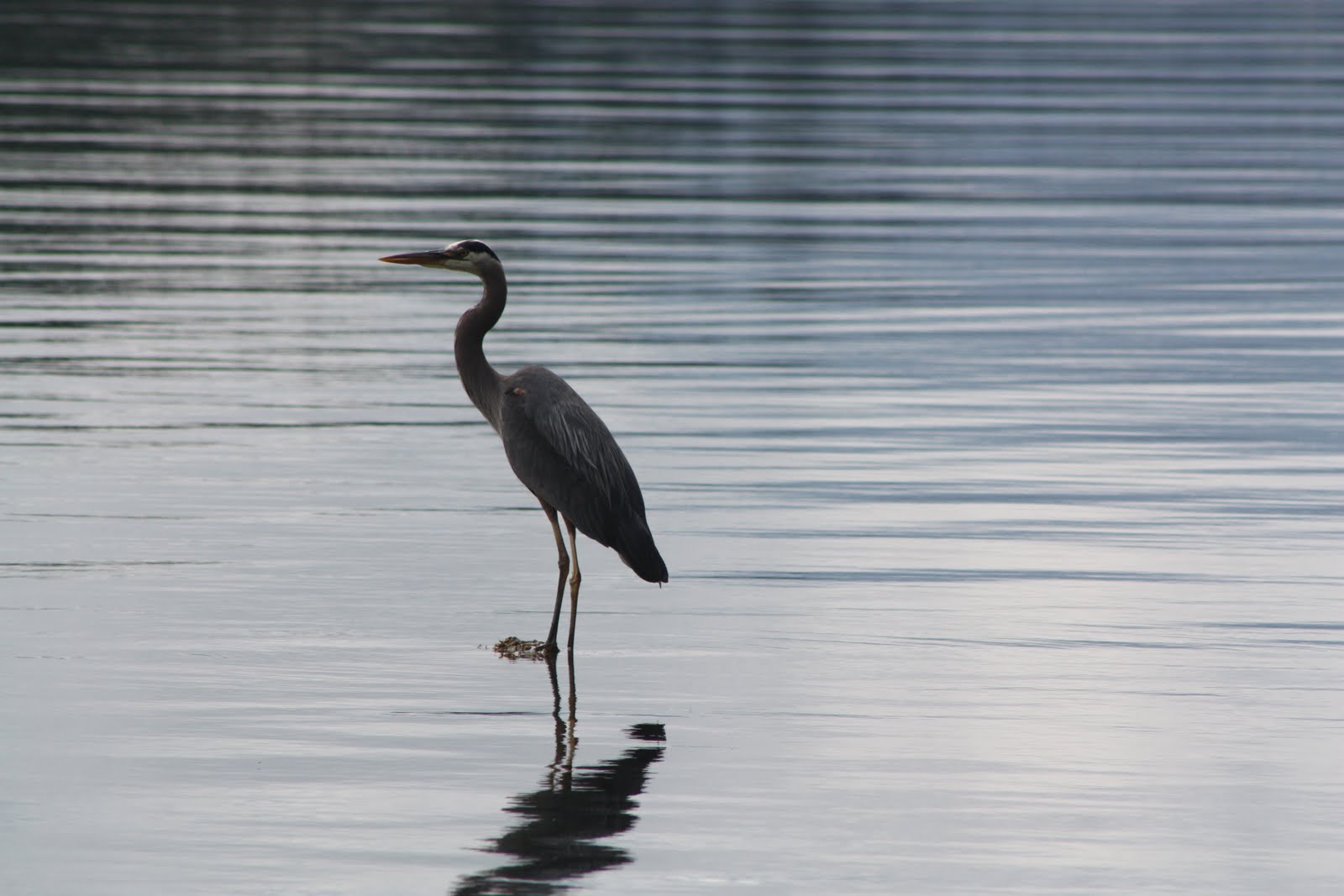
A little farther afield, this elegant juvenile Great Blue Heron (ardea herodias) was fishing at Brickyard Beach yesterday afternoon. Note the lack of plumes on the juvenile and its grey body. And if you have a big screen on your computer you might be able to make out the beginnings of the shoulder epaulets. Unlike other herons, in flight the 'great blue' folds its neck back over its shoulders in an S-shape rather than stretching it out in front.
 |
| A typical toddler stance? |
Violet-green swallow nestlings almost visible ...
And today at Folklife Village, right outside the bookshop, a violet-green swallow nestling started poking its head out of the nest as the mother flew in with food. Within a couple of days we should be able to see them all lined up along the eaves!
And today at Folklife Village, right outside the bookshop, a violet-green swallow nestling started poking its head out of the nest as the mother flew in with food. Within a couple of days we should be able to see them all lined up along the eaves!


