Search This Blog

Tuesday, May 8, 2012

Baby Bird Tips

Thank you to GROWLS for providing the following suggestions
about what to do if you find a baby bird.   

GROWLS Pager: 250-714-7101

If a nestling is out of its nest
If the bird is cold to the touch, warm it by gently holding in hands. When warm, replace in nest. DO NOT FEED!

If both the nestling and nest are ‘down’
Tie nest back in tree in about the same place, if possible. Use heavy twine because bird can get entangled in thin string. If the nest is torn apart, make a new one out of a margarine tub lined with dryer ling, DRY leaves, or shredded paper towel. Do not use grass, mud, or cotton. Place drainage holes in the bottom of the tub. Tie nest back in tree using heavy twine. Watch from a distance. If parent birds have not returned in two hours, call GROWLS.

If you see a fledgling (feathered but cannot yet fly) on the ground without its parent
Birds often fledge, or jump from the nest, a few days before they can fly. The parents will continue to care for them on the ground until the babies can fly. Leave the fledgling alone unless it appears to be injured or sick. Keep children and animals away. If someone has already picked up the fledgling, put it in a bush or low branch of a tree near where it was found. If the parents are not back in 4-6 hours, call GROWLS.

Fledged white-crowned Sparrow at Folklife Village last summer.
Not to worry, mother was close by - see next photo.  

Mother keeping close watch

If you see an orphaned or precocial baby with no parent nearby
If the bird is running around the yard, leave it alone. Keep children and animals away. The parent is likely nearby. If the baby has wandered into a building and is separated from its parents, put it outside and watch from a distance for the parents to come. If the baby appears weak or sick, call GROWLS.

GROWLS Pager: 250-714-7101

Tuesday, May 1, 2012

Eagle & Owl Released Today!

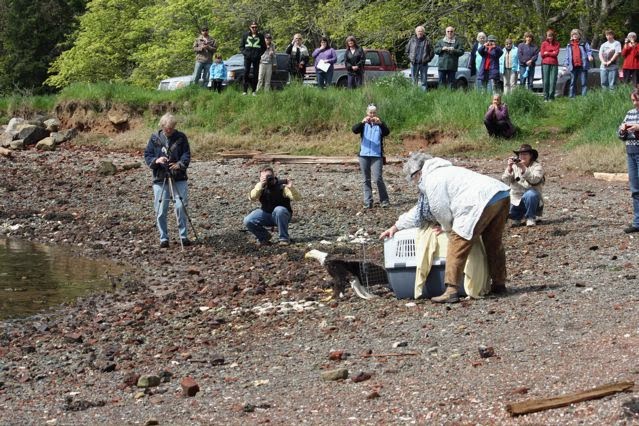
This afternoon more than twenty islanders gathered to watch as a Barn Owl and a Bald Eagle came home to Gabriola to be released close to where they were initially rescued. Both birds had been injured in the wild, rescued by GROWLS, and taken off-island for treatment and rehabilitation.

The Barn Owl, a species of special concern, is a rare resident in the southeastern Vancouver Island region. This one was released at the end of Dorby Road off Peterson.


Barn Owl ready for release back into the forest


Bye-bye cage! (Photo thanks to Tawny Capon)


I'm outa' here! (Photo by Tawny Capon)

As soon as the owl flew into the woods (after relieving himself after the long car ride!) crows and ravens began makng themselves known. Perhaps they were letting everyone know an old neighbour had returned home?


FIRST EAGLE RELEASE ON ISLAND
This Bald Eagle, released today at Brickyard Beach, is the FIRST one ever to be rescued on Gabriola, taken off-island for treatment and rehabilitation, then successfully returned to the island for release. So today was very special ...


A good crowd gathered at Brickyard Beach to honour and quietly cheer on the eagle.
(Photo thanks to Tawny Capon)

A wet feet beginning. (Photo by Tawny Capon)

Off he goes! (Photo by Tawny Capon)


A Few Bald Eagle facts:
  • This most majestic of birds is a common resident of the southern coast of BC
  • Eagles don't mate until they have their characteristic white head and tail feathers, at about four or five years old
  • When they do mate, it's for life
  • Many reuse their nests year after year, adding sticks each season until the nest is massive!
  • Their chicks are hatching now - or very very soon!

For more about the Bald Eagle check out the GROWLS website: http://www.growls.ca/


Thursday, March 22, 2012

Welcome Rufous hummingbird!

Yesterday, March 21, the first Rufous hummer this year showed up at our feeder. Today he was zipping by my head while I was in the garden. I love spring!!

I don't have a record for last year but two years ago the first Rufous arrived at our feeders on March 19. Since 2012 is a leap year, the one I saw yesterday arrived just one day later.

Colin at the Backyard Bird and Nature Store in Nanaimo reports that they have had reports of Rufous from as far north as Qualicum Beach so far.

Friday, March 16, 2012

Is your hummer feeder up?

The Rufous hummingbirds have completed most of their 6000 kilometre migratory journey from Mexico, were seen early this week in southern Vancouver Island, and should be here on Gabriola very soon - or might be NOW! I read in Monday's Sounder that someone reported Rufous hummers already flitting around the island, and I must admit I thought I saw one in our Japanese cherry tree last Saturday BUT I didn't have my binos with me and didn't get a good enough look to know FOR SURE that it wasn't an Anna's - which are here year round. So I contacted the 'senior' birders ar Birding in BC for info. Those who responded said there have been no confirmed reports of Rufous in the mid-island-Nanaimo area yet. If you think you've seen a RUFOUS hummer on the island already (look for the rufous-coloured sides on both male and female) please leave a note in the Comments section below. 


Rufous hummingbird at our feeder last year

In any case, it's definitely time to put out your feeders. One part white sugar (not honey or organic sugar or any other 'healthier' alternative) to 3 1/2 to 4 parts water should do it. Please do not colour the water! The red dye isn't good for the hummingbirds and is unnecessary, since they are attracted by the red of the feeder itself. And please be sure to refill and clean your feeders every week or so - and more often once it warms up.


Feeders help hummers
Once in a while someone asks me if it isn't 'better' to just let hummingbirds get their food naturally, from native plants. (This same question applies, of course, to all birds, and is a philosophical/ecological question I will set aside for today but may take up at another time.)

For me, the answer is "No, it isn't better for them." In an undeveloped, pristine, edenic world, the hummers would, I'm sure, not need artificial feeders to help them refuel after their 6ooo kilometre trip from Central America, but that's not the world we/they live in. Providing nectar is the LEAST we can do, given all the plundering and deforestation and pollution and other acts of violence against the earth we, as a species, have already committed - and continue to commit. This just makes their migratory journeys more and more challenging. 

The value of human-supplied nectar lies not only in its ready availability but also in its 'efficiency' for the hummers. In a 2011 study (Dartmouth University) researchers confirmed that hummingbirds (unlike humans!) feed according to "Optimal Foraging Theory". Basically, this means that their intent is to balance the energy spent finding food with its caloric benefit in order to maximize their chances of survival. (In human terms, they wouldn't bother eating donuts because the nutritive value isn't worth the time and energy spent to ingest then digest them.) Since the flowers that hummers eat from produce just enough nectar to allow them to be pollinated, hummers need to expend energy flying from flower to flower in order to find sufficient nectar. Given their high metabolism and energy requirements, there is a point at which a cost-benefit analysis says 'this just ain't worth it'. That's why, according to the Dartmouth study, hummingbirds aim to choose the largest flower patches with the 'sweetest' nectar concentrations. (To read the summary of the study from the Dartmouth Undergraduate Journal of Science, go to  http://dujs.dartmouth.edu/wp-content/uploads/2011/06/11s_final-34-36.pdf) This is why I continue to advocate for feeders.


Just make sure you don't wear red in the vicinity!

Fun coming up!
Soon we'll be sitting on the deck watching the territorial squabbling of the hummers as they stake out their places at the feeders. Luckily, they are rarely damaged in their 'battles' since their instincts tell them to protect those long life-giving bills. And once they settle in, we might get to watch those amazing courtship displays. I hope ...

Enjoy!

Tuesday, February 21, 2012

Birds of a Feather

Did you ever see a bird fly upside down? Or backwards?

Did you know a Northern Gannet can pick its mate out of a roost of thousands - that all look the very same to me!

Have you ever seen the ballet-like mating dance of the Reddish Egret?  Or the courtship dance of Sandhill Cranes?

Did you know the tail of a chickadee acts as a third wing in flight? Or that vultures soar for hours on currents without so much as the flap of a wing? Or that Magnificent Frigatebirds fish, eat, digest, and rest in flight?


I learned all this and much more yesterday at the Nanaimo Museum. The show, Birds of a Feather, is a travelling exhibition from The Museum of Nature in Ottawa and includes walls of the stunning bird photography of Ralph Hocken as well as educational displays. And the gift shop is well-stocked with bird supplies from Nanaimo's Backyard Wild Bird and Nature Store, sponsors of the exhibit.


My favourite part of the exhibit was a video called Our Feathered Friends: Flying High by the National Museum of Natural Sciences. I happened upon it half-way through and plopped myself down on a bench, mesmerized, to watch. But when it was over I couldn't find a way to turn it back to watch from the beginning. Luckily, a kind museum volunteer tracked down someone who came and opened up the cupboard underneath the VCR player and rewound the video for me. It was worth the wait! What a fascinating show. If it's not playing when you go, do take the trouble to ask for assistance. You won't regret it.

The exhibit runs to May 21 and costs only $2.00 ($1.75 if you're over 55 - what a deal!). If you're interested in birds (and I am assuming you are since you are reading the blog!) don't miss it. The Nanaimo Museum is a short walk from the Gabriola Ferry. Just walk up Front Street (heading east) and turn left at the Port Theatre corner. The museum is just up the hill past the library.

Enjoy!

Tuesday, February 14, 2012

Contamination Alert

An outbreak of salmonella poisoning in BC has already killed at least 50 pine siskins, probably caused by contaminated feeders. Read the Vancouver Province news story here:

http://www.theprovince.com/health/songbirds+salmonella+outbreak/6147520/story.html

Then PLEASE join me in giving all your feeders and bird baths a very good scrub. One part bleach to 9 parts water should do the trick.

Tuesday, February 7, 2012

Great Backyard Bird Count!

The Great Backyard Bird Count, an annual winter event, takes place this year from February 17 - 20. Let's make sure Gabriola birds are well-represented.

For information about the count go to http://www.birdsource.org/gbbc/whycount.html

Here are a few photos (with identification comments) of a few of the Gabriola birds you might see during the count:

Spotted Towhee

It may be hard to tell from this picture,
but these large sparrows have remarkable red eyes.
 
 
Pair of purple finches

Note the raspberry wash down the backs of the purple finches


House Finch

Compared to the raspberry colouring of the male "Purple" Finch, the male House Finch usually has a true red head and breast. It's colouring can, however, be affected by his diet and can range from a yellowish-orange to this vibrant red.
In any case, his elaborate song doesn't change much! 


Red-headed sapsucker

The Red-breasted Sapsucker is the only local woodpecker with a completely red head, chin and upper breast. Even if you can't see him, you'll know he's nearby
by his distinctive irregular drumming.  


Female Northern Flicker with Steller's Jay looking on

Note the impatient Steller's Jay in the background waiting for this female Northern Flicker to finish her breakfast. The lack of a red "moustache" reveals her gender. 


Male Northern Flicker

Here's the male - note the red moustache.


Varied Thrush

The lovely Varied Thrush was once a finalist for the BC Provincial Bird,
but lost to the Steller's Jay. If a bird's song had been the deciding factor,
surely this thrush would have won, hands down.   


And last but surely not least, the unique California Quail, common now on Gabriola. 
   
That's all for now. Enjoy the count!