Search This Blog

Thursday, June 14, 2012

Golden-crowned Sparrows: such majestic visitors

If you live on Gabriola Island you already know that I write a monthly column called Just for the Birds for The Flying Shingle, our local newspaper. But I've discovered that, thanks to the world wide web, many people from much farther afield often read this blog. (What can I say? Birders are everywhere!) So I'm going to post a link to my column each month, starting today. This month's article is about a flock of "goldies" that came to visit our yard for several days in early May.

To read it just go to http://www.flyingshingle.com/ then click on Columns and scroll down to the heading Just for the Birds.

Golden-crowned Sparrow

Golden-crowned Sparrow, front view

I hope you enjoy it!


Sunday, June 10, 2012

June Birds and their babies!

The yard is alive with families of birds right now including chickadees, spotted towhees, woodpeckers, and robins. It's hard to get any work done - so much fun watching them ... 


Baby chestnut-backed chickadee waiting to be fed


It's been so entertaining watching the baby chickadees, who peep peep peep like crazy, practicing their flying from one tree to another. I'm pretty sure I hear the parents cheering them on! (By the way, chickadees eat caterpillars!)


Baby Spotted Towhee on back deck


Several baby towhees fledged about 10 days ago. I haven't seen the nest although it must have been somewhere well-hidden in the back garden since they always retreat there.


Mama towhee feeding baby


 Sorry about the poor quality of the above photo - I took it through the window.


Mama Hairy WP feeding baby


The baby's feathers are so fluffed out, it almost looks bigger than the parents!


More June Yard Birds


Female Black-headed Grosbeak


Her mate


A Pair of Hairy Woodpeckers sharing suet


American Goldfinch


The goldfinches are here now and some will stay to breed. They use thistle down to line their nests (their mating season coincides with its blooming) so if you want to encourage them to make a nest close by, be sure to leave some thistle plants in your yard or garden. One less thing to weed!


Red-breasted Nuthatch

These guys often hang upside down to feed. And they eat caterpillars too!

That's all for today. I hope you're enjoying the abundance of birds around now!


Tuesday, June 5, 2012

Inside Birding

The Sapsucker Woods team from the Cornell Lab have created a FREE 5-video YouTube series on bird identification skills. It's called Inside Birding and it's GREAT! It covers the 4 key elements of bird identification: Shape & Size, Behaviour, Colour Pattern, and Habitat. There's also a final video specifically about warblers.


Walkway sign at Sapsucker Woods
(taken during our trip there in 2008)

I'm sure all but the most experienced birders (and ornithologists) will learn something. If not, you'll at least get to see a lot of different birds up close & personal!

Enjoy! Here's the link: http://www.youtube.com/watch?v=ridajl8uic0&feature=BFa&list=PL89FAA014C9EF59BC


Friday, June 1, 2012

It's an Olive-sided Flycatcher!

Earlier tonight I was pulling weeds when I first heard the song - an unfamiliar but very distinctive three-note tune coming from high up in the trees behind our house. Needless to say, all weeding stopped. I scanned the trees with my binoculars - no luck. The song kept playing intermittently, fuelling my curiosity - which was quickly becoming a minor obsession. At one point I thought I saw a bird WAY UP in a distant tree but it was too far away to even know for sure that it was a bird, so I went in and got my scope. With that I could see the outline of the bird but it was too far away to make out the colouring or shape. But I noticed that it behaved like the flycatchers I had watched in Mexico, sallying out from the top of a tree to catch flying insects and returning to the same perch. Could it be a flycatcher? Here, on Gabriola?


Olive-sided Flycatcher
Photo by Dominic Sherony - CC License

I went in, got out my BC Bird Songs CD, and played all the tracks of flycatcher songs until - yes, that's it!! - an olive sided flycatcher! (It was kind of like finally being able to scratch a serious itch!) The song is described as sounding like "quick three beers" - with the emphasis on the 'three'.  You can listen to the song at http://www.allaboutbirds.org/guide/Olive-sided_Flycatcher/sounds

At Cornell's All About Birds site I discovered that the olive-sided flycatcher, which comes to BC from South America to breed in the summer, is rated Near-Threatened by the IUCN.

If you live on the north end of the island, I hope that this post will save you the angst of trying to identify the unusual birdsong coming from the forest. Of course, it's possible there are olive-sided flycatchers on the south end too - has anyone heard or seen one??

Thursday, May 10, 2012

The Birds and The Bear

There have been several reports of bear sightings in the Berry Point area over the last couple of days. The Conservation Officer (CO) has confirmed that the scat does indeed look like that of a bear.


Picture of bear scat provided by GROWLS

If you see the bear, please call the RAPP line at 1-877 -952-7277. The CO would like to keep track of the bear just to make sure no problems arise.

Note that bears like birdseed! So if you are concerned about having him in your yard it might be a good idea to take down any bird feeders.

Tuesday, May 8, 2012

Baby Bird Tips

Thank you to GROWLS for providing the following suggestions
about what to do if you find a baby bird.   

GROWLS Pager: 250-714-7101

If a nestling is out of its nest
If the bird is cold to the touch, warm it by gently holding in hands. When warm, replace in nest. DO NOT FEED!

If both the nestling and nest are ‘down’
Tie nest back in tree in about the same place, if possible. Use heavy twine because bird can get entangled in thin string. If the nest is torn apart, make a new one out of a margarine tub lined with dryer ling, DRY leaves, or shredded paper towel. Do not use grass, mud, or cotton. Place drainage holes in the bottom of the tub. Tie nest back in tree using heavy twine. Watch from a distance. If parent birds have not returned in two hours, call GROWLS.

If you see a fledgling (feathered but cannot yet fly) on the ground without its parent
Birds often fledge, or jump from the nest, a few days before they can fly. The parents will continue to care for them on the ground until the babies can fly. Leave the fledgling alone unless it appears to be injured or sick. Keep children and animals away. If someone has already picked up the fledgling, put it in a bush or low branch of a tree near where it was found. If the parents are not back in 4-6 hours, call GROWLS.

Fledged white-crowned Sparrow at Folklife Village last summer.
Not to worry, mother was close by - see next photo.  

Mother keeping close watch

If you see an orphaned or precocial baby with no parent nearby
If the bird is running around the yard, leave it alone. Keep children and animals away. The parent is likely nearby. If the baby has wandered into a building and is separated from its parents, put it outside and watch from a distance for the parents to come. If the baby appears weak or sick, call GROWLS.

GROWLS Pager: 250-714-7101

Tuesday, May 1, 2012

Eagle & Owl Released Today!

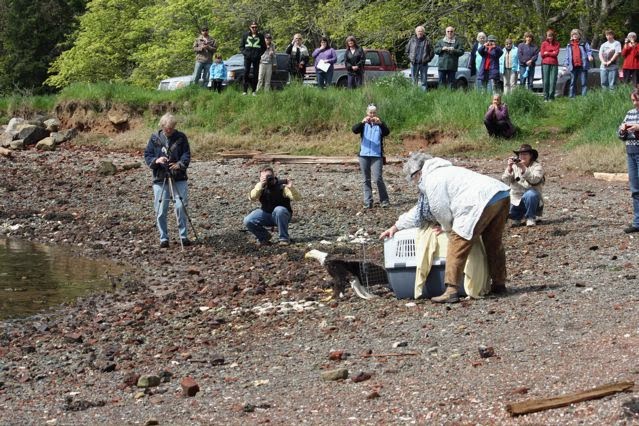
This afternoon more than twenty islanders gathered to watch as a Barn Owl and a Bald Eagle came home to Gabriola to be released close to where they were initially rescued. Both birds had been injured in the wild, rescued by GROWLS, and taken off-island for treatment and rehabilitation.

The Barn Owl, a species of special concern, is a rare resident in the southeastern Vancouver Island region. This one was released at the end of Dorby Road off Peterson.


Barn Owl ready for release back into the forest


Bye-bye cage! (Photo thanks to Tawny Capon)


I'm outa' here! (Photo by Tawny Capon)

As soon as the owl flew into the woods (after relieving himself after the long car ride!) crows and ravens began makng themselves known. Perhaps they were letting everyone know an old neighbour had returned home?


FIRST EAGLE RELEASE ON ISLAND
This Bald Eagle, released today at Brickyard Beach, is the FIRST one ever to be rescued on Gabriola, taken off-island for treatment and rehabilitation, then successfully returned to the island for release. So today was very special ...


A good crowd gathered at Brickyard Beach to honour and quietly cheer on the eagle.
(Photo thanks to Tawny Capon)

A wet feet beginning. (Photo by Tawny Capon)

Off he goes! (Photo by Tawny Capon)


A Few Bald Eagle facts:
  • This most majestic of birds is a common resident of the southern coast of BC
  • Eagles don't mate until they have their characteristic white head and tail feathers, at about four or five years old
  • When they do mate, it's for life
  • Many reuse their nests year after year, adding sticks each season until the nest is massive!
  • Their chicks are hatching now - or very very soon!

For more about the Bald Eagle check out the GROWLS website: http://www.growls.ca/