Search This Blog

Tuesday, June 17, 2014

Protecting the Birds of the Salish Sea

On June 4 last year I submitted my concerns about Enbridge’s Northern Gateway Pipeline (NGP) to the Joint Review Panel of the National Energy Board (NEB). Here’s the part of my submission that focuses on birds:

Do you know how much oil it takes to kill a sea bird? One teaspoon. 


Oiled ducks after the Exxon-Valdez spill.
(Photo: CC license.)

And how many actually survive, even after cleaning? Estimates run from one to ten per cent. Yes, between 90 and 99 per cent die anyway. Some scientists have said it’s a waste of effort. This quote is from Spiegel Online International (May 2010): 

“ ‘Kill, don’t clean,’ is the recommendation of a German animal biologist, who this week said that massive efforts to clean oil-soaked birds in Gulf of Mexico won’t do much to stop a near certain and painful death for the creatures. Despite the short-term success in cleaning the birds and releasing them back into the wild, few, if any, have a chance of surviving, says Silvia Gaus, a biologist at the Wattenmeer National Park along the North Sea in the German state of Schleswig-Holstein. ‘According to serious studies, the middle-term survival rate of oil-soaked birds is under one percent,’ Gaus says. …. Catching and cleaning oil-soaked birds often times leads to fatal amounts of stress for the animals, Gaus says. Furthermore, forcing the birds to ingest coal solutions – or Pepto Bismol, as animal-rescue workers are doing along the Gulf Coast— in an attempt to prevent the poisonous effects of the oil is ineffective, Gaus says. The birds will eventually perish anyway from kidney and liver damage.” … 


“It’s a small world, and what happens on the BC coast will affect all those birds that use the Pacific Flyway as their migration route between South or Central America and Alaska and the Boreal Forest. To devastate the coast is to affect not just BC birds but all those that rely on a hospitable BC coast for their migratory journeys.


The Boreal Forest, which over half of North America's
300+ breeding bird species call home.

I was one of 1,161 people who submitted comments to the public hearing. Two commenters were in favour of the project; 1,159 were opposed. So it was distressing, to say the least, when the NEB approved the project, albeit with conditions. Then, today, Prime Minister Harper "announced" (via a press release!) that the project was a GO. This after the people of Kitimat said NO by referendum in April and after First Nations peoples said "absolutely not" and after thousands upon thousands of BC citizens consistently voiced their opposition to the pipeline through petitions and polls and letters and rallies.

Now I’ve been accepted as a commenter on the Kinder Morgan Pipeline (KMP) Expansion project. But what's the point? 

Still, I can’t shake the images of our beaches covered in oil, of herons, gulls, cormorants, and geese suffocating as oil clogs their pores. At least, if I submit by thoughts, they will become part of the public record. I will have spoken out on behalf of the birds whose habitat is at grave risk, but who cannot speak for themselves. 

The Kinder Morgan Pipeline runs from Edmonton to the Westridge Marine terminal in Burnaby BC, where tankers are loaded before they make their way through the First and Second Narrows, Vancouver Harbour, English Bay, Georgia Strait, the active channels of the Southern Gulf Islands, Haro Strait, and the Strait of Juan de Fuca. If the KMP is expanded, approximately 400 giant oil tankers will travel these waters every year.


The Salish Sea carbon corridor.
(Thanks to the Wilderness Committee.)

To make matters worse (much worse), two internationally-recognized Important Bird Areas (IBAs), Burrard Inlet and Active Pass, lie along this route. These IBAs provide key habitat for nesting, wintering, and migrating birds.

Active Pass is a biologically-rich feeding area for fish-eating birds during the spring, fall, and winter and also supports significant populations of Pacific Loon and Brandt’s Cormorant in winter and Bonaparte’s Gull on migration. 


Brandt's Cormorant.
Photo by Teddy Llovet - CC license. 

Burrard Inlet supports the Western GrebeBarrow’s GoldeneyeSurf Scoter, and Great Blue Heron as well as the Purple Martin, Pelagic and Double-crested CormorantOsprey, and Bald Eagle


Barrow's Goldeneye.
Photo by Donna Dewhurst - CC license


Purple Martins.
Photo by Don Wigle.


Great Blue Heron.
Photo by Sharon McInnes. 

So I'll probably participate in the Public Hearing. But one thing I know for sure: commenting publicly won’t be enough. 


A version of this article was published 
in The Flying Shingle (www.flyingshingle.com) on June 16 2014


Thursday, April 24, 2014

My (new) Favourite Hummer Feeders

To feed or not to feed? It's a question we need to take to heart. Today I'm going to talk just about hummingbirds but the question applies all species of birds. 

I started feeding Rufous hummingbirds six or seven years ago. Since then, they've provided me with untold hours of amusement and fascination every spring and summer in return for my keeping the feeders stocked and clean.

Rufous hummingbirds trying their darnedest to share

Then, two years ago, an Anna's showed up. That changed things. No more just 'fair weather feeding'. Believing that Anna's (we have a pair now) rely on human-supplied nectar to get them through the coldest days of winter, my responsibilities increased. Now, when the temperatures plummet, I monitor the feeders to make sure the nectar doesn't freeze before I get outside (sometimes donned in boots and snow gear) to replace it with fresh nectar. For weeks this winter my days revolved around the status of the hummingbird feeders. (Good thing I'm officially retired!) 

Female Anna's

I'm more than willing to continue this routine, and even to call on my wonderfully obliging friends and neighbours to take over for me during the winter when I have to be off-island for a while. BUT ... and this is a big BUT ... I don't want my penchant for feeding the hummers to put them at risk. One of the risks is disease, especially a fungal infection known as 'hummingbird tongue'. An Oregon blogger wrote about this infection here: Sick hummer

What to do? It seems to me there are two options:

1. Stop feeding the hummers entirely. Let nature take its course. Maybe plant more hummingbird-attractive native plants in the garden.

2. Keep feeding them (or just feed the Anna's in the winter) but be VIGILANT about keeping feeders CLEAN and EDUCATE neighbours to do the same.

For now, I'm choosing the second option. To make it easier, I've bought two new feeders that are much easier to keep clean. The base of these comes apart. No more fiddling with Q-tips!! Here are my two new feeders:

I bought this feeder, by Perky Pet, at Cultivate Garden & Gift in Parksville.
They had LOTS of styles, many of which were easy-to-clean.

I like the size of the feeder above for the spring and summer when there are so many Rufous around. The top holds 32 ounces and the top is a Mason Jar that can be replaced by any same-size Mason jar if it should break. It did take the hummers a few hours to get used to their new feeder (the other one had a red base) but they're fast learners, obviously!


Although slightly smaller, the base comes apart easily for easy cleaning.
Note: the glass is red. The nectar inside is clear - just water and sugar. No dye!!
Also by Perky Pet. 

The hummers went for this one right away! Red is clearly their favourite colour.

There are lots of other issues to explore in the "to feed or not to feed" debate: the increased risk of predation, window strikes, feeding hummers Rogers sugar that may be GMO ... and the list goes on. More another day. Thanks for visiting.

Monday, April 14, 2014

The Sex Life of Crows

By Sharon McInnes

If the title of today’s column made you sit right up and take notice (that was, I admit, my goal), I should warn you that for crows, getting to sex isn’t simple. It involves a lot of planning, preparation, and patience. As Kevin McGowan explained in the webinar “The Secret Life of Crows”, before a crow can land a mate, he has to find a suitable breeding territory. (Scientists call this ‘acquiring breeding status’.) That can be a big job.


American Crow
Photo by Kevin McGowan


Here’s how it works. Let’s say you are, for example, a male crow and you live in the city. Unlike most other species of birds, you could stay home for up to six years, helping to raise your brothers and sisters. Your tasks would include helping with nest-building, feeding, and chasing predators away. (A lot of male crows do this; females tend to leave home much earlier.) Called ‘cooperative breeding’, this strategy is almost as advantageous to your extended family – and to crows in general – as having your own offspring. McGowan says of crows that practice cooperative breeding: “Some of these families are amazing. One marvellously successful crow family lives at St. Catherine’s Church in Ithaca – a breeding pair and up to seven generations of siblings live on or next to the home territory there.


A Family of Crows
Making dinner plans? Discussing a territorial dispute? Gossiping about a neighbour?
Photo by Junior Libby - CC license. 


And there are substantial rewards for staying home to help. One is that you’re more likely to inherit your parents’ territory when they die. In the meantime, they might allow you to use part of their breeding territory to raise your own family. But don’t get excited too quickly. You won’t be getting started in that venture for a while: the average age of initial breeding in McGowan’s study was 4.9 years.

If the ‘one big happy family’ scenario doesn’t turn you on, you have options! One is to find your own territory. Since you live in the city you’ll need about 10 acres. (Country crows tend to have much larger estates.) Of course it needs certain attributes. For one thing, it has to be available. You don’t want to have to battle another crow that’s already set up house there. And it must have plenty of food nearby. (I know – you’re a ‘city crow’ and you’ll eat anything. But your babies need nutritious food – the same kind they’d be getting if you lived in the country.) 

No? Well, if trying to establish your own territory sounds risky, you could join an already established group. This has potential, especially down the road. For example, when the male adult of the mated pair you join dies, you could simply replace him. No need for the widow to go hunting for a new guy when you’re there, ready, willing, and able, right? Or, in another scenario, they might both die, and you could inherit their territory.

Or maybe one of your older siblings has already struck out on his own and would welcome your help?  Or maybe a friendly neighbourhood crow? However be aware that neighbours – especially helpful ones – are known to be philanderers. So if you decide to share the territory of a neighbour, there’s a chance (up to 20 per cent) that at least one of your babies might look more like him than you. Then again, I’d be remiss if I didn’t mention that the same hanky-panky is known to happen between relatives. So you can’t necessarily trust your woman with your brother or cousin or uncle either.  And I hate to even bring this up, but if you and your lady stay together for a few years, and have a few babies, there is a chance that she and one of your sons will get together one night. BUT of all the philandering that goes on amongst crows (scientists refer to this behaviour as ‘extra-pair copulation’) only 3.5 per cent of it is between mother and son. That’s heartening, right?

Still, there’s a good reason for sticking close to home to raise your family: crows that do are more ‘successful breeders’. Compared to robins, for example, which have a 25 per cent nest success rate, the American Crows that McGowan studied had a 60 per cent success rate. Those are pretty good odds, for a bird.


This article was first published in The Flying Shingle (www.flyingshingle.com) on April 7 2014

Big Clean Windows, Little Dead Birds

Most of us know about the "Bird Strike" problem. A bird sees reflected scenery (in a window) and flies into it. Hits the glass. Thunk. Broken neck, dead bird.

Sometimes the bird is "just stunned" and eventually "recovers" but often dies later of internal injuries or other injuries that render it less able to survive in the wild.

There ARE solutions! One is BirdTape from the American Bird Conservancy. I just ordered some to install on the windows of our new Garden Room. It's inexpensive and research-based.


To read about ABC Bird Tape (and order it) click here

For more on the seriousness of the problem, check out this article in the Birds on the Brain blog. Even though this piece is about Duke University in the States, the problem exists EVERYWHERE, even here on little old Gabriola Island!


Wednesday, March 26, 2014

The Galveston Bay Oil Spill

On the ABA blog today, Laura Erickson writes about the recent Galveston Bay oil spill: 

"The March 22 spill of 168,000 gallons of highly toxic bunker fuel into Galveston Bay can be expected to take a huge toll on migrating, nesting, and still-wintering birds." 

Click below to read the article: 
The Galveston Bay Oil Spill - what we birders can do

Note: the same thing could happen here. In fact, with every additional tanker sailing the Salish Sea, the stakes go up ... way way UP. 


What would Kinder Morgan's proposed pipeline expansion mean for the billion birds of the Pacific Flyway?

It would mean very bad news, not just when there's a spill but from chronic oiling that happens as a matter of course when oil tankers habitually traverse a waterway like the Salish Sea.

CRED BC (http://credbc.ca/) has done some excellent work on the history of spills and leaks along the existing Trans Mountain Pipeline and on the economic risks and benefits of Kinder Morgan's proposal to expand the pipeline. The following two graphics are theirs.


And I wrote about the issue in a Bird Canada article last month. You can read it here.


Thursday, March 20, 2014

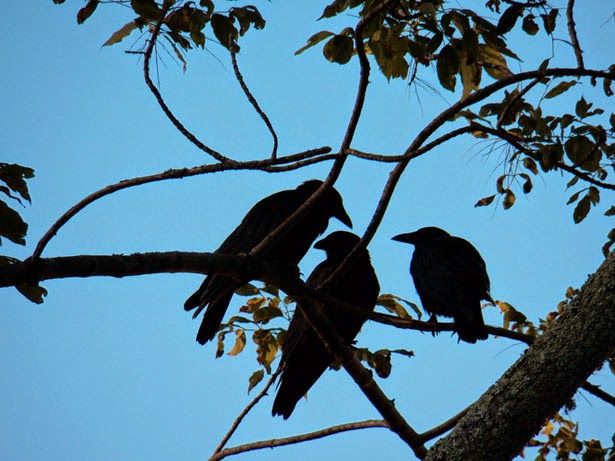
A Bouquet of Crows

by Sharon McInnes

During a Cornell Lab webinair called The Secret Lives of Crows, our instructor, Dr. Kevin McGowan, urged us to avoid the term “a murder of crows” on the basis that it’s unscientific and perjorative.  He’d prefer, he said, “a bouquet of crows. ” So, in honour of McGowan’s more than 25 years studying the social and reproductive behaviour of the American Crow (Corvus brachyrhynchos), a bouquet it is.

American Crow
Wikipedia image

McGowan does his research in Ithaca New York, home of Sapsucker Woods and the Cornell Lab of Ornithology. Here on Gabriola, we have the Northwestern Crow (Corvus caurinus) which is slightly smaller than the American Crow and has a more nasal call but “is so similar that the two may in fact be the same species.” (http://www.allaboutbirds.org/guide/Northwestern_Crow/id) Given the similarities, I think it’s fair to assume that his findings apply to our local crows too.

Three Northwestern Crows conferring.
Photo by Junior Libby - CC license. 

For decades now, crows have been making headlines when they roost, in the tens of thousands, in cities. A 2010 article in The Vancouver Sun refers to that city, my home town, as “The City of Crows”. Certainly when I stay at my daughter’s in the West End, I’m regularly awakened by the raucous calling of crows, and cannot take a walk along the seawall without crossing paths with dozens of them. But it hasn’t always been like this. Crows only started moving into cities, in large numbers, in the 1980s. During the webinair McGowan explained that this press into urban environments had multiple causes but was due in part to the fact that hunting is banned in cities. Crows have been hunted – by farmers and “sport” hunters – since the dawn of time, and still are, as this 2009 post by a Pennsylvania hunter, Bob Aronsohn, attests:

Then my friend … and I shot an additional 6,932 crows from November to February.  Our largest shoot last season was 543 crows in one day. We had several over 400 and quite a few in the two and three hundred range. The main reason I love to hunt crows so much is because you just don't setup just anywhere and expect to have a good shoot. It takes plenty of scouting in order to line up a good shoot. I don't get good shooting all the time, sometimes I just don't get in the right spot.  (http://www.gofoxpro.com/site/crow-hunting)

So, who can blame the crows, intelligent, social, family-oriented beings that they are, for choosing to leave the country?  Besides safety from hunters, city living offers the advantages of readily-available food (since crows have adapted to scavenging our leftovers) and fewer predators such as raccoons, jays, squirrels, owls, and hawks, an asset that is especially important during nesting season. McGowan’s research shows that city and suburban nests are subject to less predation than rural nests. In total, 57% of city nests compared to 48% of rural nests are successful.  

There are also disadvantages, though, to leaving one’s home in the country. For one thing, that city ‘fast food’ is less easily digestible than the crow’s natural diet: invertebrates, fish, snakes, frogs, small birds and mammals, bird eggs, nestlings, fruit and seeds.  Besides being less nutritious, the garbage that crows ingest in cities also carries the risk of contamination. This may not be a big deal for an adult crow but it can be deadly for a nestling.

In the end, though, the advantages and disadvantages of the two habitats appear to cancel each other out, in terms of nesting success, and they end up with the same number of fledglings.  Even though fewer rural babies survive, the ones that do are bigger than their city counterparts.  They’re heavier by 40-50 grams, have longer legs and bills, and possibly (although this not yet proven) larger brains.  McGowan and his team wondered: what makes the difference?  Turns out it’s all that good old country food. Researchers discovered this by feeding their city crows the kind of food mama crows would feed their babies in the wild. The result? Bigger nestlings.  It seems that crows, like humans, will eat junk food, to their detriment, just because it’s there.

This article was first published (with fewer images)
in the Flying Shingle on March 10 2014.